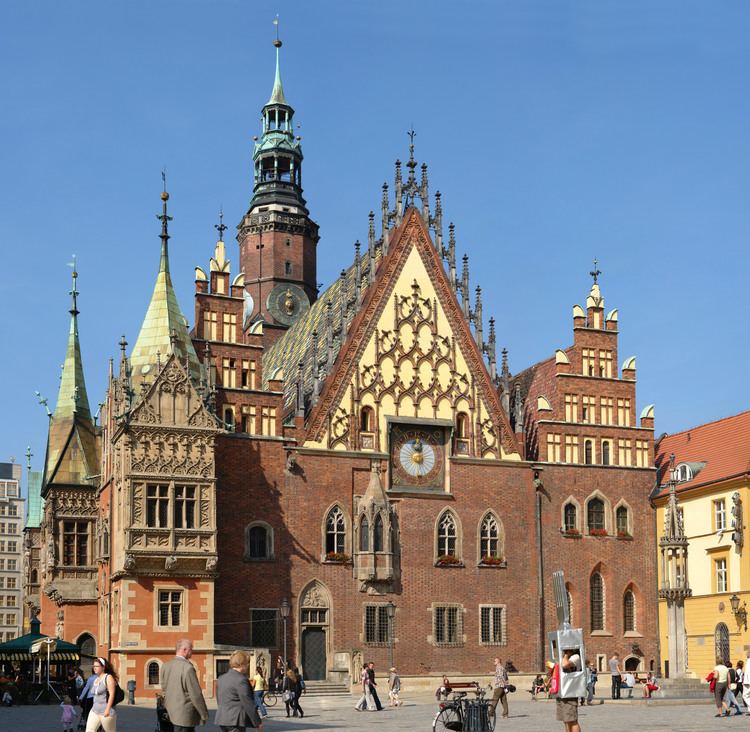
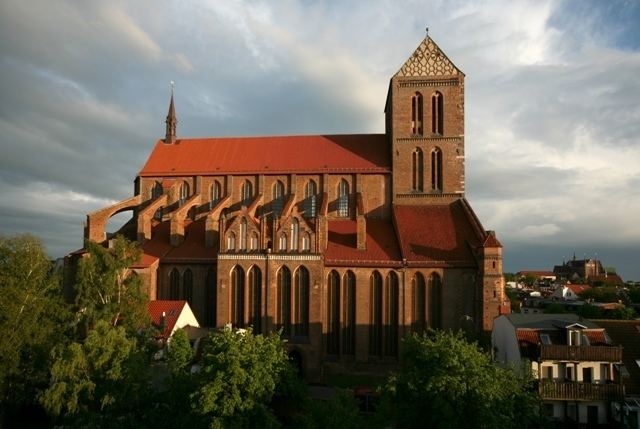
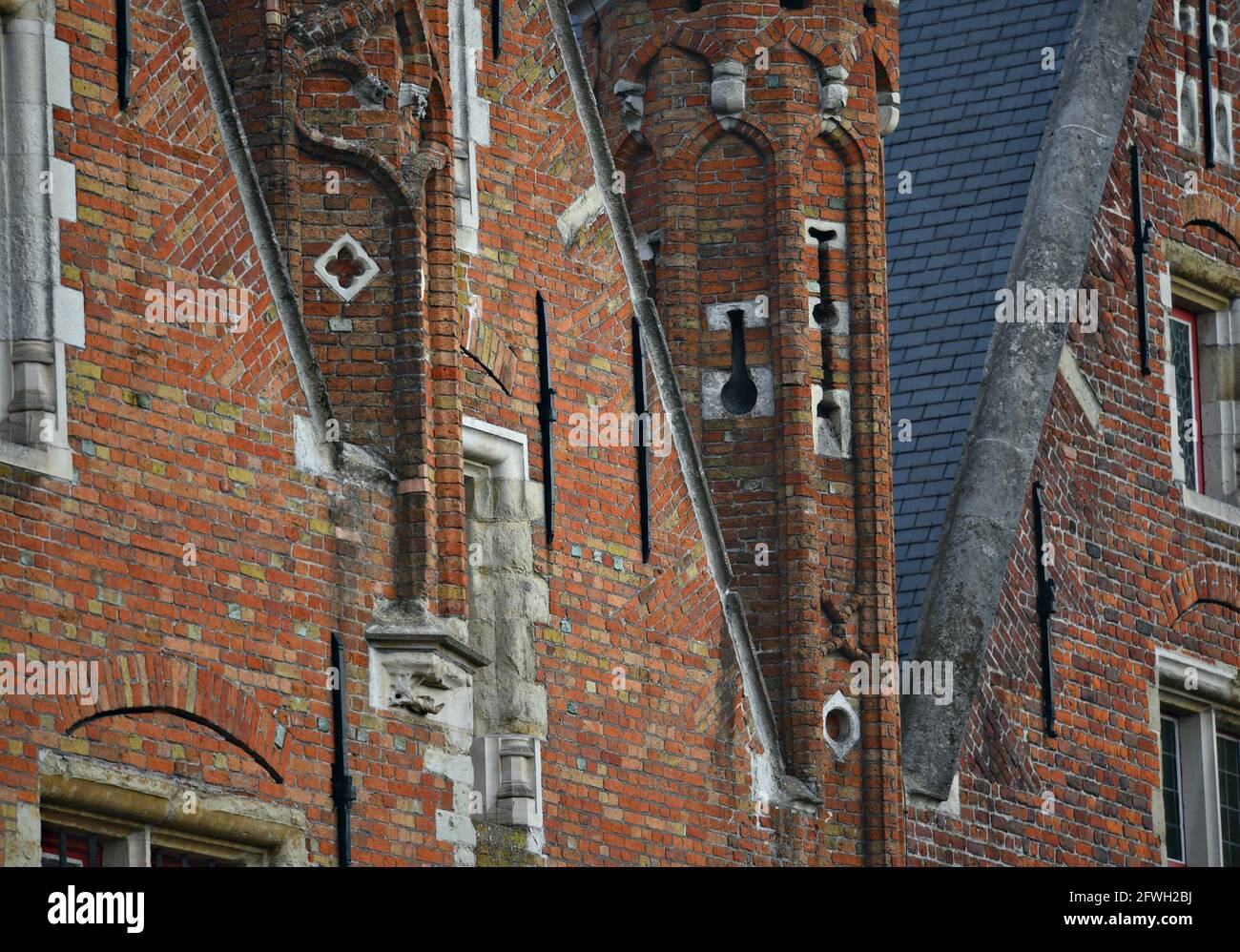
The term Brick Gothic is used for what more specifically is called Baltic Brick Gothic or North German Brick Gothic. That part of Gothic architecture, widespread in Northern Germany, Denmark, Poland and the Baltic states, is commonly identified with the sphere of influence of the Hanseatic League. But there is a continuous mega-region of Gothic brick architecture, or Brick Gothic in a sense based on the facts, from the Strait of Dover to Finland and Lake Peipus and to the Sub-Carpathian region of southeastern Poland and southwestern Ukraine.
Out of northern Germany and the Baltic region, the term Brick Gothic is adequately applied as well.
The region around the Baltic Sea, including Northern Germany, has some typical characteristics, but there are also regional and social differences, such as between the churches of medieval big cities and those of the neighbouring villages. On the other hand, a significant number of Gothic brick buildings erected near the Baltic Sea could also have been built in the Netherlands or in Flanders, and vice versa.
Furthermore, Gothic brick structures have also been erected in other regions, such as northern Italy, southwestern and central France, and in the Danubian area of southern Germany. The particular architectural styles of some regions differ very much from the others, these are Italian Gothic (with Lombard Gothic, Venetian Gothic and Tuscan Gothic), French Gothique Méridional. Quite late began the medieval use of brick in England, with the Tudor Style.
The true extent of northern Brick Gothic and other Gothic brick architecture is shown by this almost complete list.
Lists
This list will never be complete. But it aims to be almost complete to give an unbiased survey as well on the variance as on the geography of Gothic brick buildings.
The dates given here refer to the present extant Gothic structures. Predecessors or post-Gothic alterations are not normally mentioned, but can be assessed by following up the literature. The most influential structures are indicated by bold print. Romanesque and Renaissance structures are not listed. Gothic Brick structures from outside the Baltic or North German regions, e.g. the Danubian ones, are also included, while Neogothic edifices are not listed.
– In long tables, vertical arrows link to the navigation boards above (after the preceding table) and below (before the next table). –
Belarus
Belgium
Public database links:
- IBE = Inventaris Bouwkundig Erfgoed (Inventory of Architectural Heritage)
Most of the Gothic brick architecture in Belgium can be found in West Flanders, some in a narrow strip along the border with the Netherlands. Many Gothic brick churches in the province of Limburg have been lost in the 19th century, as they were displaced by Gothic Revival churches.
West Flanders
East Flanders
Province of Antwerp
Limburg
Hainaut
Flemish Brabant, Walloon Brabant & Brussels
Czech Republic
Denmark
Background informations:
- NM-DK = Digitized pages, available on the websites of the National Museum, of the compendium of Danmarks Kirker ("Churches of Denmark"). It has been published since 1927, but the digitized pages mostly are of editions of the 1990s. On the linked subpage, you have to cklick for a PDF with the title "... Kirke". The description you load down begins with some history. After that, the churchyard is described and after the churchyard, mostly beginning with the headline "BYGNING", the church building itself. In this list, sometimes simply is written "PDF", sometimes an identification of the volume and the number "BYGNING"-page.
- Trap = Statistik-Topographisk Beskrivelse af Kongeriket Danmark (Statistical-Topographical Description of the Kingdom of Denmark, initiated by Jens Peter Trap and continued by H. Weitemeyer, V. Falbe-Hansen & H. Westergaard. The 1st edition 1856–1860, 2nd edition 1872–1879 & 3rd edition 1898–1906 are available on Runeberg edition of Nordic literature. As a non-commercial volunteer project providing original texts, it can be considered equivalent to Wikisource.
North Jutland
– Danish "Region Nordjylland" –
Mid Jutland
– Danish "Region Midtjylland" –
South Jutland
– Jutland part of Danish Region "Region Syddanmark";
that is much more than traditional "Sønderjylland" –
Funen
and adjacent islands
Zealand
and adjacent islands
Lolland and Falster
England
In England, the use of bricks for pretentious buildings began later than in continental Europe. And the collective of Gothic brick buildings differs, almost no religious buildings and very few urban ones.
Estonia
Finland
France
Hauts-de-France with French Flanders
Alsace
Central France, south and west of Orléans
In the Loir-et-Cher department, there is a small group of Gothic brick buildings. One of them even is among the most famous buildings of France, though not for its bricks.
(Ducal) Burgundy and Franche Comté region
In Middle Ages, the same rulers were Dukes of Burgundy as French vassals and Counts of Burgundy as vassals of the Holy Roman Empire.
Forez
– Between Burgundy and Languedoc –
Southern France around Toulouse
(*) "Our-Lady's-Assumption Church" = Église Notre-Dame-de-l'Assomption
Germany
See List of Gothic brick buildings in Germany
Hungary
– In Hungary, there is much more hidden than visible medieval brick. During the 145 years of Ottoman occupation, many churches fell in ruins. At about 1700 they were restored, inclusively of plastering, which need not necessary have existed before. In ruins of the Turkish wars and of World War II, brick can be visible, though these buildings had been plastered in their time of function. –
Italy
Abruzzo
Emilia-Romagna
Liguria
Lombardy
Marche
Piedmont
Tuscany
Veneto and Friuli-Venezia Giulia
Latvia
Lithuania
Netherlands
See List of Gothic brick buildings in the Netherlands
Poland
See List of Gothic brick buildings in Poland
Russia
Historical Russia
Kaliningrad exclave
Slovakia
Sweden
Until 1658, Malmö, Lund and Helsingborg were Danish.
Switzerland
Though brick generally is not typical for medieval Swiss architecture, there are also some Gothic brick buildings in Switzerland, and some more have disappeared.
Ukraine
Except of Lutsk Castle, all buildings are not very far from the current Polish border, though Gothic buildings also can be found in Lviv and Stryi, some of them looking like plastered brick buildings.
See also
- European Route of Brick Gothic
Bibliography
- Angela Pfotenhauer, Florian Monheim, Carola Nathan: Backsteingotik. Monumente-Edition. Monumente-Publikation der Deutschen Stiftung Denkmalschutz, Bonn 2000, ISBN 3-935208-00-6
- Marianne Mehling (ed.): Knaurs Kulturführer in Farbe Estland, Lettland, Litauen. München 1993. ISBN 3-426-26608-3
- Marianne Mehling (ed.): Knaurs Kulturführer in Farbe: Finnland. München 1988. ISBN 3-426-26248-7
References
External links
- Media related to Brick Gothic at Wikimedia Commons